On 22 and 23 September 2026, ICT Filtration Group will take part in Farmaforum at IFEMA Madrid with its specialist brands ICT PharmaLine and TrébolCAD.
At stand F32, we will present filtration and sieving solutions for the main pharmaceutical wet granulation operations, together with sieving and classification equipment used across the manufacture of oral solid dosage forms.
Our aim will be to analyse the process from an overall perspective. The selection of a filter, screen or classification unit affects not only the performance of a specific operation: it can also influence production continuity, product reproducibility, maintenance activities and documentation requirements.
Wet granulation: a process that requires technical coordination
Wet granulation brings together several critical operations in the manufacture of oral solid dosage forms. From powder blending and granulation through to the final milling of the dried product, each stage has specific requirements.
Production needs reliable components that reduce interruptions and maintain equipment performance. Engineering must ensure dimensional, mechanical and functional compatibility. Quality, in turn, requires suitable materials, traceability and documentation consistent with the intended use.
Collaboration between these three areas makes it possible to define specifications more effectively and anticipate potential issues before the component is installed or validated.
Solutions for every stage of pharmaceutical wet granulation
At Farmaforum 2026, we will showcase solutions for high-shear granulators, wet mills, fluid-bed dryers and dry mills.
Vent filters for high-shear granulators
During high-shear granulation, the venting system must allow air displacement while helping to retain product particles.
ICT PharmaLine develops vent filters adapted to the characteristics of the equipment and the process. Their specification takes into account factors such as geometry, dimensions, filter media, mounting system, operating conditions and cleaning requirements.
An appropriate specification facilitates filter integration into the equipment and helps maintain stable operation.
Conical screens for wet mills
After granulation, the wet mass may pass through a mill to control its size before drying. In this operation, screen geometry and perforation influence product behaviour and the resulting particle size distribution.
For wet mills, ICT PharmaLine supplies conical screens with square and grater-type perforations.
Selection is based on the mill model, the characteristics of the wet mass, the required capacity and the target particle size. Expected wear, ease of cleaning and actual production conditions should also be considered.
Filters for fluid-bed dryers
In fluid-bed drying, the filter elements must promote air circulation and prevent particle loss during the process.
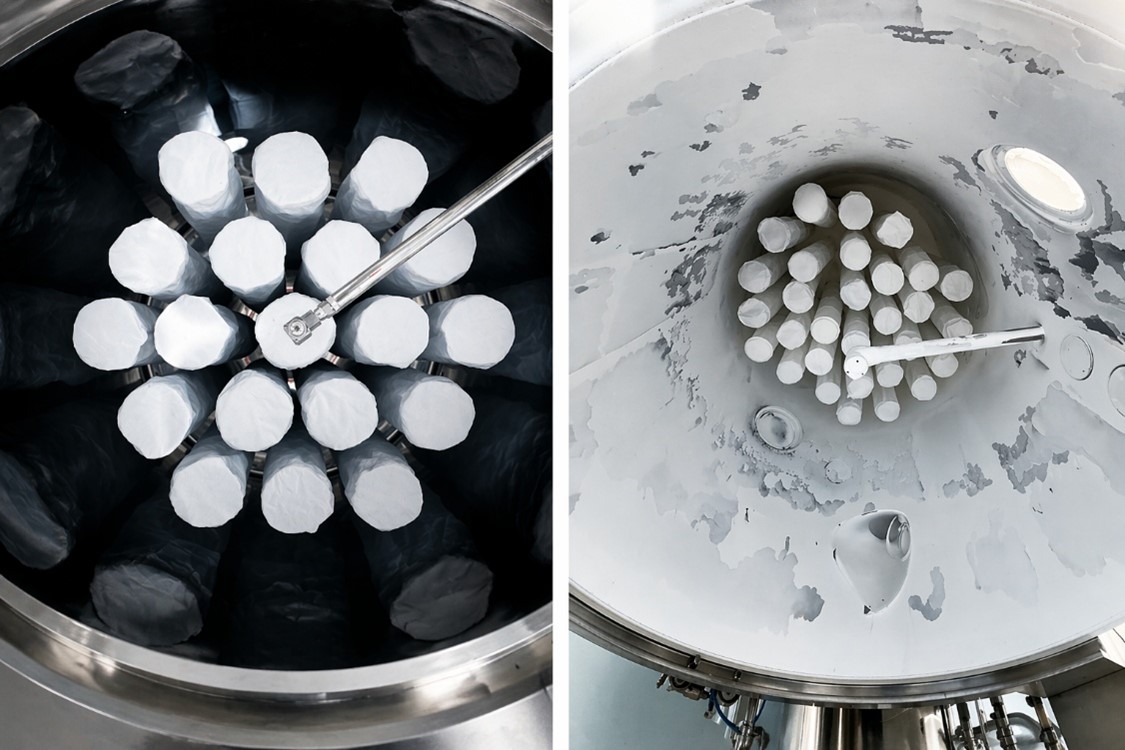
ICT PharmaLine offers different filter-element configurations, including dynamic filters, cartridges and multi-bag systems.
The solution must be adapted to the equipment design, product properties and operating conditions.
For Production, process stability and ease of cleaning are key considerations. Engineering must verify fit and the fastening system. Quality must assess materials, traceability and the available documentation.
Screens for dry mills
Once dry, the granulate may require further milling to achieve the specified particle size distribution before final blending, compression or encapsulation.
ICT PharmaLine supplies conical, oscillating and rotary screens for dry mills.
Their configuration should be defined on the basis of the inlet and outlet particle size distribution, equipment capacity, product sensitivity and maintenance requirements.
Correct screen selection helps maintain process consistency and reduce deviations associated with granule size.
Sieving as a cross-process operation in the manufacture of oral solid dosage forms
Sieving and classification requirements do not end with granulation.
In the manufacture of oral solid dosage forms, these operations may be present at different points in the process, from raw-material receipt through to the stages before and after compression or encapsulation.
Through TrébolCAD, ICT Filtration Group manufactures vibratory sieving and classification equipment for different operations within pharmaceutical manufacturing.
Raw-material receipt and preparation
Active pharmaceutical ingredients and excipients may require safety sieving before they are introduced into the process.
This equipment can remove foreign bodies, agglomerates or oversized particles and condition the product before it proceeds to the next manufacturing operations.
Before blending operations
Sieving can be used to condition powders, break up or remove agglomerates and prepare the product before it is introduced into blending operations.
After granulation and drying
Once the granulate has been produced and dried, sieving and classification equipment can be used to control its particle size distribution and separate different size fractions before the product proceeds to the next process stages.
Before compression or encapsulation
At later manufacturing stages, sieving can perform product-control functions before feeding the compression or encapsulation operations.
In certain applications, it can also be used to remove dust, fines or agglomerates before the product proceeds to the next manufacturing stages.
In this way, vibratory sieving is a cross-process technology in the manufacture of oral solid dosage forms, complementing the specific filters and screens installed in granulators, mills and fluid-bed dryers.
What should each area evaluate?
The selection of a component or piece of equipment should take into account both its function within the process and the requirements of the different areas involved.
Production: continuity and performance
Production should assess process stability, component service life, replacement frequency, ease of cleaning and the impact of any incident on the manufacturing schedule.
Using filters and screens adapted to the product and equipment helps reduce unplanned interventions and supports more reproducible operation.
Engineering: integration and maintenance
Engineering should review dimensions, geometry, fastenings, materials, perforations, finishes and service conditions.
It should also consider access to the component or equipment, installation, inspection, cleaning and spare-parts availability.
When an existing part needs to be reproduced, drawings, photographs, samples and equipment references help define the solution correctly.
Quality: traceability and documentation
Quality should confirm that the component is suitable for its intended use and that the available documentation meets the needs of the regulated environment.
Depending on the solution and application, ICT PharmaLine components can be supplied with technical documentation for GMP, ATEX and FDA regulated environments and in accordance with EU Regulation 10/2011.
Defining these requirements at the start of the project helps avoid subsequent requests and facilitates the internal evaluation of the component.
A solution defined around the application
Two pieces of equipment intended for the same operation may differ in design, dimensions or fastening systems. Likewise, the same equipment may process products with very different behaviours.
For this reason, selection should not be based solely on a standard reference. To define a solution, it is advisable to analyse:
- The equipment and its configuration.
- The dimensions and mounting system.
- The product characteristics.
- Temperature, pressure and operating conditions.
- The required particle size distribution or filtration level.
- Cleaning and maintenance procedures.
- Materials, finishes and documentation requirements.
This approach makes it possible to align the needs of Production, Engineering and Quality before a component or piece of equipment is manufactured, replaced or incorporated into the process.
ICT Pharmaline and TrébolCAD at Farmaforum 2026
Farmaforum will be an opportunity to review specific pharmaceutical wet granulation applications and, from a broader perspective, the different filtration, sieving and classification requirements involved in the manufacture of oral solid dosage forms.
Our team will be able to analyse both components directly associated with granulators, mills and dryers and the sieving and classification requirements that may arise at different stages of manufacturing.
We will be able to review issues related to component service life, adaptation to the equipment, product losses, changes in perforation or particle size distribution, cleaning requirements, part reproduction and documentation requirements.
We look forward to welcoming you at stand F32 to learn about your application and identify the most suitable solution.
Farmaforum 2026
22 and 23 September 2026
IFEMA Madrid | Stand F32
Get your professional pass courtesy of ICT Filtration Group via this link.
You can also contact our team of specialists at any time via the following link: İLETİŞİM