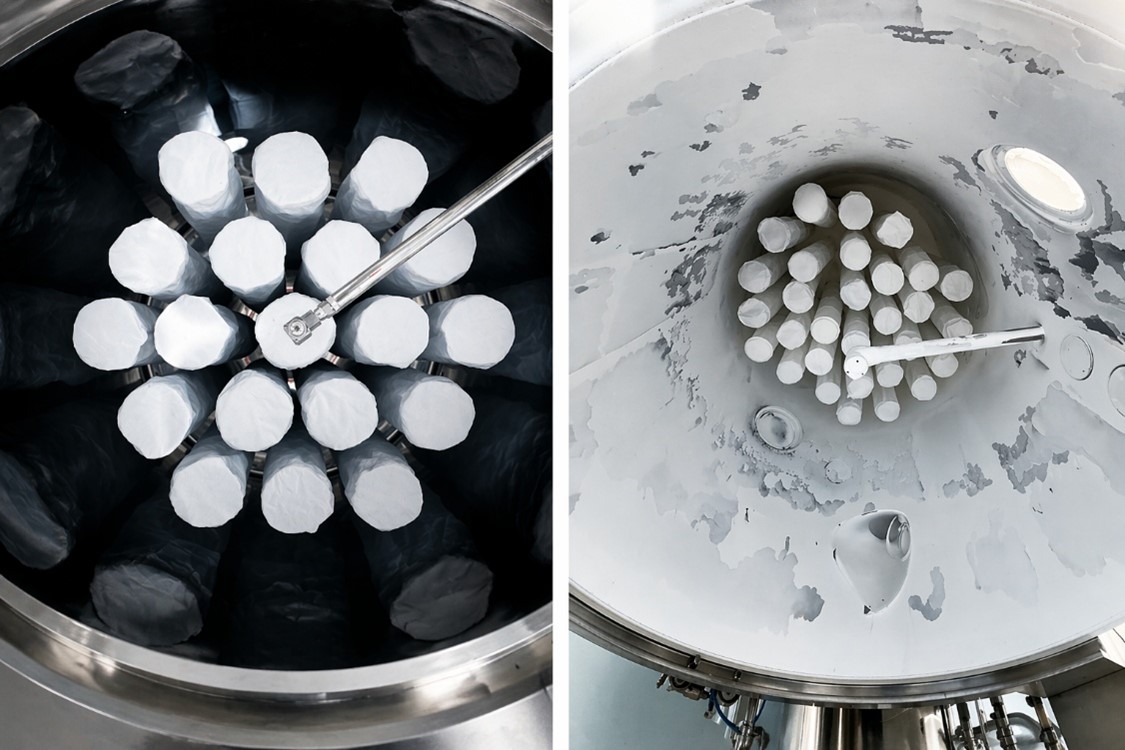

Filter cloths and bags for pharmaceutical centrifuges are critical components in solid–liquid separation processes in the pharmaceutical and fine chemical industries, especially when working with organic solvents and ATEX-classified atmospheres.
In filtration centrifuges—vertical or horizontal, batch or automatic—the actual performance of the equipment does not depend solely on the mechanical system. The filter medium installed inside the basket has a direct influence on:
The filter medium installed inside the basket has a direct influence on:
- Separation efficiency
- Residual moisture in the solids
- Recovery of fine particles
- Batch-to-batch repeatability
- Process safety
Correctly selecting centrifuge filter bags is essential to ensure stable, safe, GMP-compliant processes—particularly in pharmaceutical operations involving organic solvents and potentially explosive atmospheres (ATEX).
 Technical function of the filter element in a centrifuge
In filtration centrifuges such as basket, peeler, pusher, or inverting filter centrifuges, the filter medium operates under high centrifugal forces and must simultaneously fulfill three functions:
- Mechanical retention of solid particles
- Formation and stability of the filter cake
- Efficient drainage of mother liquor and wash liquids
In pharmaceutical processes using organic solvents and alcohols, the behavior of the filter fabric is decisive in preventing:
- Carry-over of fines and API losses
- Increases in drying times
- Irregular cake discharge
- Electrostatic risks in the presence of flammable solvents
Technical criteria for selecting filter media in pharmaceutical centrifuges
Type of centrifuge and operating mode:
The design of the filter bag or liner must be adapted to:
- Vertical or horizontal batch centrifuges
- Manual or automatic discharge systems
- Equipment with integrated washing, drying, and inerting
Basket geometry, fastening systems, and the dynamic stresses of the process determine the construction of the filter medium.
Micron rating and filter structure:
Micron rating directly affects:
- Filtrate clarity
- Drying performance
- Recovery of fine solids
Depending on the application, the following are used:
- Monofilament filter fabrics – facilitate cleaning and cake release
- Multifilament fabrics – higher fine-particle retention
- Metallic or hybrid media – for applications with high mechanical demands
Materials and chemical compatibility with solvents
Material selection is critical in pharmaceutical processes involving organic solvents, repeated washing cycles, and GMP validations.
The most used materials for pharmaceutical centrifuge filter cloths include:
- Polypropylene (PP)
Excellent chemical resistance to alcohols and many organic solvents. Standard choice for many applications. - Polyester (PET)
High dimensional stability and mechanical strength. Compatible with many solvents within defined pH and temperature ranges.
- Polyamide (PA)
Flexible and abrasion-resistant, but hygroscopic. Its use must be carefully evaluated in processes involving moisture and alcohols.
- PEEK (Polyether Ether Ketone)
High-performance material for aggressive solvents, elevated temperatures, and high-value APIs. Maximum chemical and mechanical stability.
- Stainless steel woven meshes – AISI 316L
Suitable for high solids loads, severe abrasion, and demanding cleaning strategies. Offer excellent durability and dimensional stability throughout the filter’s service life.
Final selection takes into account pH, temperature, solvent, operating regime, and CIP strategy.
CIP resistance and repeated cleaning
In GMP-regulated environments, filter bags must maintain their integrity after multiple cleaning and drying cycles, without deformation or loss of permeability.
This is especially important in solvent-based processes, where deterioration of the filter medium can compromise process validation and product quality.
ATEX atmospheres and electrostatic control
The combination of flammable solvents, fine powders, and high rotational speeds makes electrostatic risk a critical consideration.
Selecting filter media for ATEX zones must account for:
- Solvent characteristics
- Centrifugation speed
- Mechanical energy of the process
- The need for charge dissipation
The complete assembly—filter element, fastening system, and grounding—must ensure electrical continuity in accordance with the area’s ATEX classification.
Advantages of custom-designed filter elements
At ICT PharmaLine we design and manufacture filter cloths and bags for pharmaceutical centrifuges fully tailored to each piece of equipment and process, considering:
- Exact basket geometry
- Fastening and discharge systems
- Nature of the solids and solvents
- Real operating conditions
Custom design enables:
- Greater process stability
- Reduced unplanned downtime
- Improved product recovery
- Longer consumable life
- GMP and ATEX compliance

Applications in the pharmaceutical and fine chemical industries
Our solutions are used in:
- Crystallization and isolation of APIs with organic solvents
- Production of pharmaceutical intermediates
- Catalyst separation
- Fine chemical and biotechnology processes
Each application is technically evaluated to propose the optimal filter medium.
Request a technical evaluation of your centrifuge
If you would like to improve the performance of your centrifuge in pharmaceutical, chemical, or biochemical applications, our technical team can analyse your process and recommend the most suitable filter medium for your ATEX and GMP environment.
Contact us through the web form and receive a personalized technical recommendation.