 In wet granulation and fluid bed drying processes, API loss is a situation that tends to appear progressively and, in many cases, is difficult to clearly identify from the outset. Although it is often associated with a specific failure, the reality is that this type of deviation rarely has a single cause.
In practice, product loss results from a balance that ceases to be stable. The behavior of the API, process conditions, fluidization quality, and the response of the filtration system continuously interact. When any of these elements deviates, even slightly, the system as a whole begins to lose efficiency.
This deterioration does not always manifest immediately in large amounts of lost material. It often begins with more subtle signals: small accumulations, changes in process dynamics, or cleaning difficulties. However, over time, these deviations can translate into a significant reduction in batch yield and lower reproducibility.
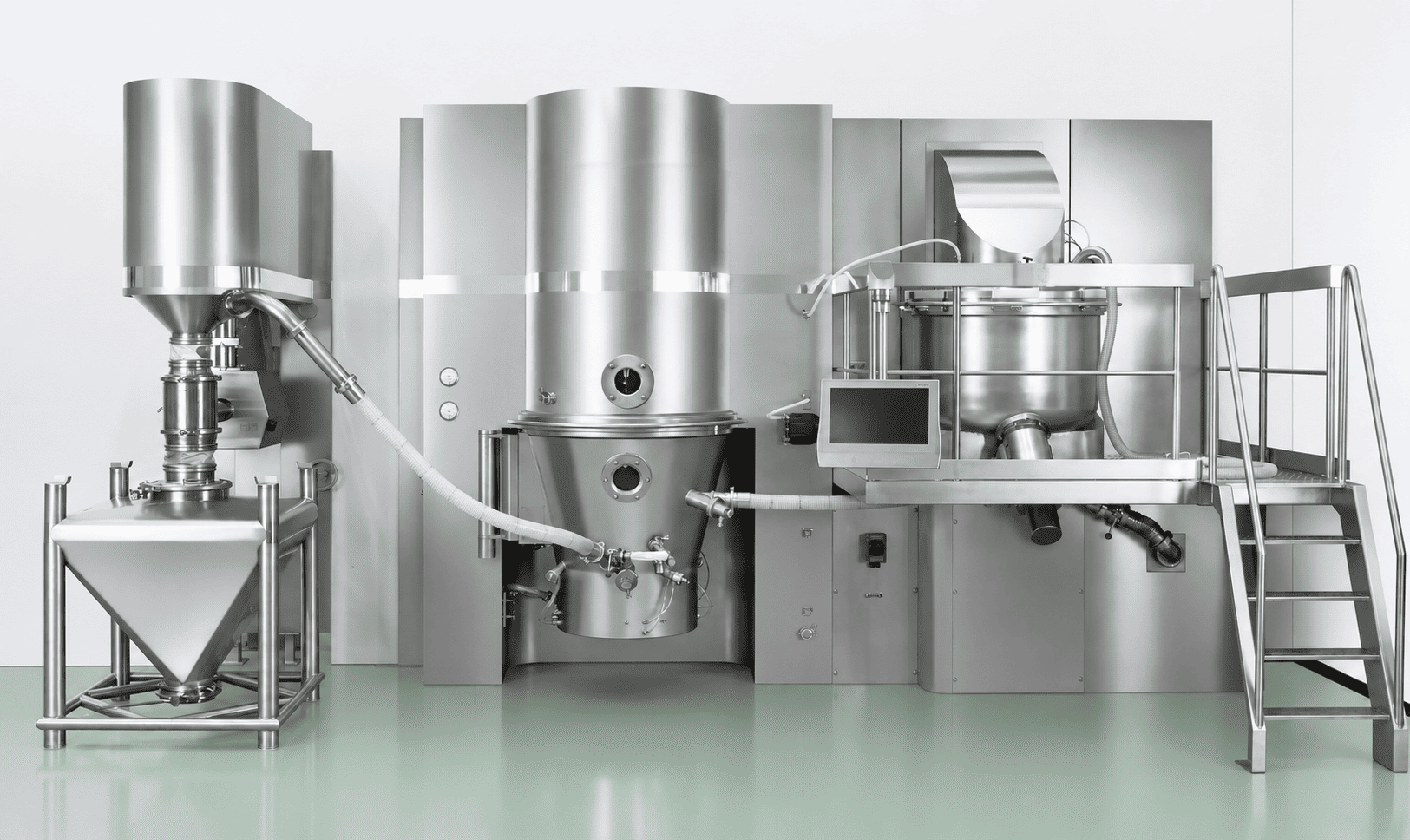
Where the product is actually lost in a fluid bed
One of the most relevant aspects is understanding that API loss does not occur at a single point. In reality, it is usually distributed across different areas of the equipment, which complicates its detection and analysis.
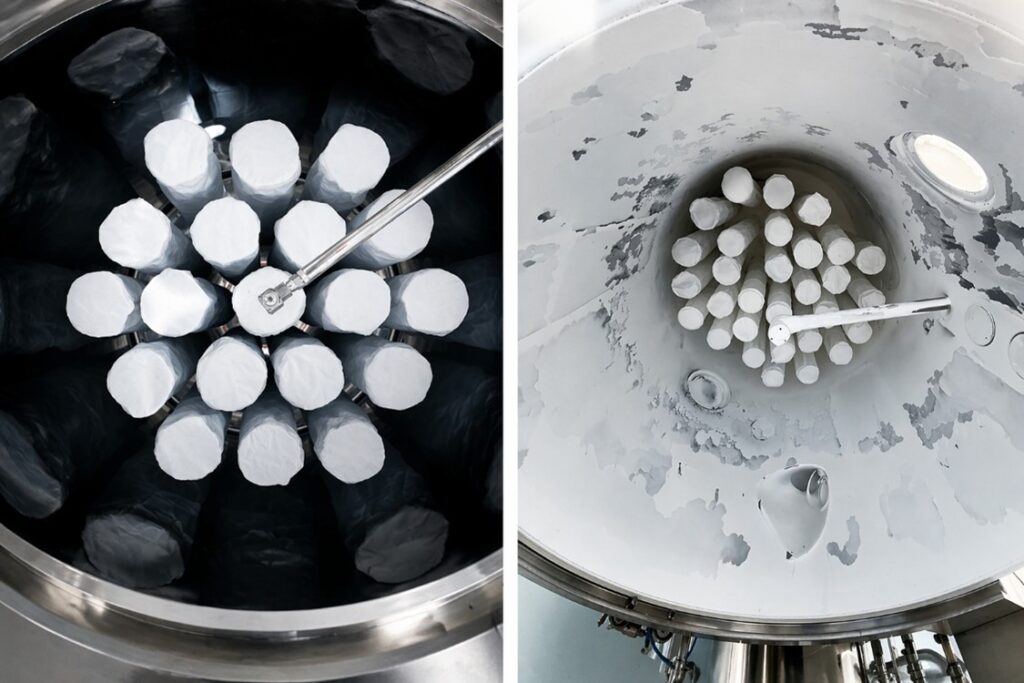
It is common to observe progressive accumulation on internal walls, where fine or partially granulated material tends to adhere. At the same time, part of the product may be carried by the airflow to the upper section of the equipment, leaving the usable bed without being recovered.
The filtration system also becomes a key point. When fine material is persistently retained or its release during cleaning is not efficient, the loss ceases to be occasional and becomes part of the process behavior itself.
A multifactorial problem: when balance breaks down
Discussing API loss in a fluid bed necessarily implies adopting a global view. Process performance depends on how multiple variables interact, which under ideal conditions should remain aligned.
The particle size distribution of the product, for example, directly determines its behavior during fluidization. A high presence of fines increases system sensitivity, facilitating both entrainment and adhesion to internal surfaces.
This is compounded by the importance of fluidization. When air distribution is not completely homogeneous, zones with lower mobility appear where material tends to accumulate. These small irregularities, which sometimes go unnoticed, can significantly alter process stability.
The spraying stage introduces another layer of complexity. If the granulation liquid is not distributed uniformly, over-wetted regions may coexist with others where fines predominate, generating a heterogeneous system that is more difficult to control.
Additionally, it should not be forgotten that some products, by their very nature, have a greater tendency toward cohesiveness or sticking. In these cases, even small variations in operating conditions can amplify losses.
The filtration system as an active part of the process
In this context, the filtration system should not be interpreted as a secondary element. Its behavior is part of the overall balance of the fluid bed and can directly influence batch performance.
The way it retains fine material, its ability to release it during cleaning, and its response under real operating conditions are factors that determine the final result. Although it is not always the origin of the problem, it can contribute to amplifying or stabilizing it, depending on how it interacts with the rest of the system.
How to address API loss from a practical perspective
When faced with a situation of product loss, the most effective approach is usually not to look for a single immediate cause, but to analyze the process as a whole. Observing how the product behaves, how the equipment responds, and how operating conditions evolve makes it possible to identify patterns that are not obvious at first glance.
In many cases, it is precisely the accumulation of small misalignments that ends up having a significant impact. Detecting and correcting them in time is key to restoring process stability and improving performance.
Conclusion: optimizing the system to recover performance
API loss in a fluid bed is, essentially, a balance problem. It does not respond to a single variable, but to the interaction between multiple factors that must remain aligned to ensure a stable process.
Optimizing these types of processes involves understanding how the system behaves under real conditions, identifying critical points, and adjusting both operating conditions and equipment elements, including the filtration system.
At ICT PharmaLine, this approach is based on practical experience accumulated in plant operations and on the detailed analysis of real situations. This perspective allows not only identifying the origin of losses, but also anticipating them and sustainably improving the performance of fluid bed processes.
Are you experiencing API losses in your fluid bed process?
Properly analyzing the root cause is key to recovering batch performance. At ICT PharmaLine, we help you identify critical factors and optimize your process with a practical approach based on real plant experience.